Aug 25
|
Check
your Canvas notifications to check you can receive Canvas
announcements.
Read
course syllabus
carefully. Make a note of the test dates in your calendar.
Review
course website
and repeat frequently during the semester.
Review the Canvas
course website.
Read
https://vancliff.utasites.cloud/T/study.pdf
and
read
https://www.jeffreybennett.com/pdf/How_to_Succeed_general.pdf
for ideas on how to study most effectively.
Read
your lecture notes (meaning the notes you should have taken during
lecture) and skim/read Section 2.1.
Do Sec 2.1: 2.
Recall
from today's lecture that a scan of the instructor's lecture notes
can be found in the Modules section of our Canvas portal.
|
Aug 30
|
Read
your lecture
notes, skim/read Section 2.1 and do Sec 2.1: 11, 8, 9.
Recall
that a scan of the instructor's lecture notes can be found in the
Modules section of our Canvas portal.
|
Sep 01
|
Read
your lecture
notes and do Sec 2.2: 1, 2.
Recall that a scan of the
instructor's lecture notes can be found in the Modules section of
our Canvas portal.
|
Sep 06
|
Labor
Day Holiday (no lecture)
|
Sep 08
|
Read
your lecture
notes and do
H1. Repeat Questions 2.2.1 and 2.2.2 for the
matrix A4
,
where

Sec
2.2: 3.
If
any of the mathematics does not display properly (e.g., an error
message received), compare with this
file.
Recall
that a scan of the instructor's lecture notes can be found in the
Modules section of our Canvas portal.
|
Sep 13
|
Read
your lecture
notes and do
H2. Let A5
be
the matrix

(a)
Use the eigenvalues of A5
to
show that A5
is
nilpotent.
(b) Determine the
smallest positive exponent k
such
that A5k
=
0.
H3. (a) Determine which of the matrices A1,
..., A4
from
Questions 2.2.1 and H1 are nilpotent.
(b) For each matrix in (a) that is nilpotent, determine the
smallest positive exponent k
such
that Aik
=
0.
Sec 2.3: 2, 3 (assume the notation in question 3 is
referring to question 2).
If
any of the mathematics does not display properly (e.g., an error
message received), compare with this
file.
Recall that a scan of the instructor's lecture
notes can be found in the Modules section of our Canvas portal.
|
Sep 15
|
Read
your lecture
notes and do
Sec 2.3: 1 and
watch the 61-minute video
on companion matrices and rational canonical form (use the link
provided or access it in the Modules section of our Canvas portal)
and then do
H4. (a) Compute the companion matrix for the
polynomial found in Question 2.3.1.
(b) Compute the companion matrix of the characteristic polynomial
of the matrix given in Question 2.1.11.
H5. (a) Suppose A
and
B
are
similar matrices. Show that Ak
=
0 iff Bk
=
0, where k
∊ ℕ.
(b)
Find the characteristic polynomial of the matrix A4
given
in H1.
(c)
Compute the companion matrix C
of
the polynomial found in (b).
(d)
Compute A42
and
C2.
(e)
Use (a) and (d) to show that A4
and
C
are
NOT similar matrices.
(H5(e)
motivates using rational canonical form instead of C.)
H6.
Find the rational canonical form of each of the following
matrices:
(a)
the matrix A4
given
in H1
(b)

(c)

(d)
the second matrix and the third matrix in Question 2.4.1.
If
any of the mathematics does not display properly (e.g., an error
message received), compare with this
file.
Recall that a scan of the instructor's lecture
notes can be found in the Modules section of our Canvas portal.
Check
Canvas for
Quiz
1 ;
it is due Sept 22.
|
Sep 20
|
Read
your lecture
notes. You
might also want to read the file
on
JCF used in Math 5333 (optional).
Do
Sec 2.4: 1 and
H7. Find the minimal polynomial of each
matrix in Question 2.4.1 and factor the polynomials.
H8. Let
A
denote
the matrix A4
given
in H1.
(a)
Find the Jordan canonical (normal) form J
of
A.
(b)
Find an invertible matrix P
such
that P-1
A
P =
J.
(c)
Factor
the minimal polynomial of A.
H9.
Let A
be
the matrix

(a)
Find the Jordan canonical (normal) form J
of
A.
(b)
Find an invertible matrix P
such
that P-1
A
P =
J.
(c)
Find the minimal polynomial of A
and
factor it.
H10. Let A
be
the matrix

(a)
Find the Jordan canonical (normal) form J
of
A.
(b)
Find an invertible matrix P
such
that P-1
A
P =
J.
(c)
Find the minimal polynomial of A
and
factor it.
H11.Let A
be
the matrix

(a)
Find the Jordan canonical (normal) form J
of
A.
(b)
Find an invertible matrix P
such
that P-1
A
P =
J.
(c)
Find the minimal polynomial of A
and
factor it.
H12.
|
What
do you notice about the (factored) minimal polynomials for the
matrices in H7-H11 and
their corresponding Jordan
canonical (normal) forms?
|
If
any of the mathematics does not display properly (e.g., an error
message received), compare with this
file.
Recall
that a scan of the instructor's lecture notes can be found in the
Modules section of our Canvas portal.
Check
Canvas for
Quiz
1;
it is due Sept 22.
|
Sep 22
|
Read
your lecture notes and do
H13. Find a vector v ∊
ℂ2
\
ℝ2
with
the
property that v · v ∉ ℝ (so
the dot product is NOT an inner product on ℂ2
).
Recall
that a scan of the instructor's lecture notes can be found in the
Modules section of our Canvas portal.
Check
Canvas for
Quiz
1;
it is due today.
Test
1
will
be 1 week from today; check Canvas for an information sheet.
|
Sep 27
|
Read
your lecture notes and do
H14. Show that the euclidean inner
product on ℂ2
is
an inner product on ℂ2.
H15.
Show that properties (c) & (e) from the definition of inner
product given in lecture imply that an inner product
satisfies
additivity on the right: (w,
u+v)
= (w,
u)
+ (w,
v)
for all u,
v, w
that
belong to the IPS.
H16. Show that properties (d) & (e)
from the definition of inner product given in lecture imply that
an inner product satisfies
conjugate homogeneity on the right:  for all u,
v that
belong to the IPS and for all α
∊ 𝔽.
H17.
Consider ℝn
with
the dot product. Let v, w ∊ ℝn
and
suppose that ||v||
= 1 = ||w||.
Show that v
– w is
orthogonal to v
+ w.
H18.
Let V denote an IPS and assume that the parallelogram inequality
holds; namely,
||u+v||2
+
||u – v||2
=
2 ( ||u||2
+
||v||2
)
for all u, v ∊ V.
If
u, v ∊ V satisfy: ||u||=3, ||u+v|| = 4,
||u – v|| = 6, what does ||v|| equal?
H19.
Assume, without proof, that the pairing
 for all ai,
bi
∊
ℝ,
defines an inner product on the
linear
space V of all 2 x 2 matrices with entries in ℝ. Use the
Gram-Schmidt formula (GSOP) on the matrices

to
produce an orthonormal set of elements in V.
H20. Suppose 𝔽
= ℝ and let V denote the space of all polynomials in the
variable x of degree at most 2 with coefficients in ℝ.
Suppose
V is an IPS with inner product ( , ) that satisfies:
(1,
1) = 1/3, (1, x) = ¼,
(1, x2)
= (x, x) = 1/5, (x, x2)
= 1/6, (x2,
x2)
= 1/7.
Let
e1
=
 ∊ V and e2
=  (4x – 3) ∊ V.
(a)
Justify that e1
and
e2
are
orthonormal.
(b)
Use the Gram-Schmidt formula (GSOP) to find 0 ≠ e3
∊ V
such that e1,
e2
and
e3
are
orthonormal.
If
any of the mathematics does not display properly (e.g., an error
message received), compare with this
file.
Recall
that a scan of the instructor's lecture notes can be found in the
Modules section of our Canvas portal.
Test
1 will be on Wednesday;
check Canvas for an information sheet.
|
Sep 29
|
Test
1 today.
|
Oct 04
|
Read
your lecture notes and look over the solutions to Test 1 in the
Assignments section of our Canvas portal, and do
H21.
Suppose
𝔽
=
ℂ and let T : ℂ3
→
ℂ2
be
defined by

where
i2
=
–1.
(a)
Using the euclidean inner product on ℂ3
and
ℂ2,
find a formula for T*:
ℂ2
→
ℂ3.
(b)
Find the matrix of T and the matrix of T*
with
respect to the standard bases of ℂ2
and
ℂ3.
(c)
Compare
your matrices in (b) with the first
remark
in the lecture on Section 3.2.
H22.
Suppose 𝔽 = ℝ and let V denote the vector space of
polynomials in the variable x of degree at most 1 with
coefficients in ℝ
and let T = d/dx : V→V.
Using the IP
 for all f,
g
∊ V,
find a formula for T*.
H23.
Let V denote a finite-dimensional IPS. Suppose u1,
u2
∊ V.
Let T : V →
V
be the linear map defined by
T(v) = (v, u1)
u2
for
all v ∊ V. Find a formula for T*.
H24.
Let V denote a finite-dimensional IPS. Let I denote the identity
operator on V; that is I(v) = v for all v ∊ V.
Justify that I*
=
I.
H25.
Let T : ℝ2
→
ℝ be
the linear map
 Using the dot product for the IP on ℝ2,
find
a vector u ∊ ℝ2
such
that (v, u) = T(v) for all v ∊ ℝ2.
H26.
Suppose 𝔽 = ℝ and let V denote the space of all polynomials
in the variable x
of
degree at most 2 with coefficients in ℝ.
View V as an IPS via
for all f,
g
∊ V.
Let T : V → ℝ be defined by
 for all f
∊ V
(where
 denotes
the derivative of f
with
respect to x).
Find u ∊ V such that ( f
,
u ) = T( f
)
for all f
∊ V.
(Hint: find an orthonormal basis of V (e.g., see the lecture notes
on Section 3.1) and
see the proof of the claim in the lecture on Section 3.2.)
H27.
(Optional)
Let
V denote the vector space of all infinite sequences v
= (v1,
v2,
.…) where vi
∊ 𝔽 for
all i and vi
=
0 for all but finitely many i.
Let ei
=
(0,..., 0, 1, 0, ....) where the 1 occurs in the i'th position.
View V as an IPS by using
 for
all v, y ∊ V, where v = (v1,
v2,
.…), y = (y1,
y2,
.…). Let T : V → V denote the linear map
 for
all v = (v1,
v2,
.…) ∊ V. (Optional: prove that T is a linear
map.)
(a) Verify that
 for
all n ∊ ℕ.
(b) Justify that the adjoint of T does not exist.
(Hint:
suppose T*
does
exist and show that
T*(en)
= (z1,
z2,
....) where zi
∊ 𝔽 for
all i, but zi
is
nonzero for infinitely many i (so T*(en)
∉ V).)
If
any of the mathematics does not display properly (e.g., an error
message received), compare with this
file.
Recall
that a scan of the instructor's lecture notes can be found in the
Modules section of our Canvas portal.
|
Oct 06
|
Read
your lecture notes and do
H28.
Show
that
AtA-AAt
is
a symmetric matrix for all nxn
matrices A (recall At
denotes
the transpose of A).
H29. Let V denote a finite-dimensional
IPS. Show that T*
○ T
– T ○
T*
is
a self-adjoint linear map for all linear maps T : V→V.
Sec
3.3: 1 (assume the IP is the dot product) and
H30. Let V
denote a finite-dimensional IPS. A linear map T : V→V
such that T*
○ T
= T ○
T*
is
called normal.
Show
that all self-adjoint linear maps are normal.
H31. For each
of the following, assume V is endowed with the euclidean inner
product.
In
each case, determine if the linear map T is self-adjoint or normal
(see previous question) or neither.
(a)
𝔽 = ℝ, V = ℝ2,
 for all x,
y ∊
ℝ.
(b)
𝔽 = ℝ, V = ℝ3,
 for all x,
y , z
∊ ℝ.
(c)
𝔽 = ℂ, V = ℂ2
,
 for
all x,
y ∊
ℂ,
where i2
=
–1.
(d)
𝔽 = ℂ, V = ℂ2
,
 for all x,
y, z
∊ ℂ,
where i2
=
–1.
If
any of the mathematics does not display properly (e.g., an error
message received), compare with this
file.
Recall
that a scan of the instructor's lecture notes can be found in the
Modules section of our Canvas portal.
|
Oct 11
|
Read
your lecture notes and do
H32. Suppose
𝔽 = ℝ and let V = span{ 1, cosx,
sinx
},
and let D = d/dx.
Assume,
without proof, that D : V→V is linear and that
 for all f,
g
∊ V
defines an IP on V
and
that f(π) g(π) = f(-π) g(-π) for
all f, g ∊ V.
(a)
Justify that D is skew-adjoint. (Hint: integration by
parts.)
(b)
Determine whether or not D is normal (see homework from the last
lecture for the definition).
(c)
Determine whether or not D○D
is normal or self-adjoint.
Sec 3.3: 2 (assume the IP is the
dot product) and
H33. Suppose 𝔽 = ℝ and use the dot
product on ℝn.
Show that
AB-BA is skew-adjoint for all skew-adjoint
nxn
matrices A and B.
H34. Let V and W denote finite-dimensional
inner-product spaces. Justify that
T*
○ T
: V→V is positive semidefinite and that
T ○ T*
:
W→W
is positive semidefinite
for all linear maps T : V→W.
If
any of the mathematics does not display properly (e.g., an error
message received), compare with this
file.
Recall
that a scan of the instructor's lecture notes can be found in the
Modules section of our Canvas portal.
|
Oct 13
|
Read
your lecture notes and do
H35. Suppose 𝔽 = ℝ and let V
denote a finite-dimensional IPS and T : V→V a linear map.
We define
b : V x V→ℝ by b(x, y) =
(x, T(y)) for all x, y ∊ V.
(a) Justify that b is a bilinear form.
(b) Justify that b is symmetric if and only if T is
self-adjoint.
H36. Suppose 𝔽 = ℝ. For each of the given
quadratic forms Q, find a symmetric bilinear form b such that
b(x, x) =
Q(x) for all x ∊ V, for a suitable V in each
case.
(a) Q : ℝ2
→
ℝ where
 for all x,
y ∊
ℝ.
(b) Q : ℝ3
→
ℝ where
 for all x,
y, z ∊
ℝ.
H37.
Suppose 𝔽 = ℝ.
(a) Determine the quadratic form corresponding to the matrix
 .
(b)
Find the symmetric matrix corresponding to the quadratic form
 for all x1,
…, x4
∊ ℝ.
If
any of the mathematics does not display properly (e.g., an error
message received), compare with this
file.
Recall
that a scan of the instructor's lecture notes can be found in the
Modules section of our Canvas portal.
|
Oct 18
|
Read
your lecture notes and do
H38. Suppose
𝔽 =
ℝ and
let

(a)
Verify that A
is
orthogonal.
(b)
Verify that the characteristic polynomial of A
is
(x+1)(x2+1)
= (x+1)(x+i)(x–i),
where i2
=
–1.
(c) Find the
eigenspaces of A
and
verify that they are orthogonal with respect to the euclidean IP
on ℂ3.
(d)
Find the new matrix that represents the linear map given by A
with
respect to the (reordered) standard basis
B
=
{e2,
e1,
e3}
of ℝ3.
(e)
Compare
the matrix in (d) with the last theorem of the lecture on Section
3.4.
(f) Compare
the basis vectors in B
with
the eigenvectors found in (c) (consider real and imaginary parts
of the entries).
If
any of the mathematics does not display properly (e.g., an error
message received), compare with this
file.
Recall
that a scan of the instructor's lecture notes can be found in the
Modules section of our Canvas portal.
|
Oct 20
|
Read
your lecture notes, especially the examples of polar decomposition
(PD) and singular-value decomposition (SVD), and read the example
in the book that appears right after Proposition 3.6.7.
H39.
Find the polar decomposition of the matrix

H40. Find the polar decomposition of the matrix A, where A
is the third matrix in Exercise 1 of Section 3.6.
H41. Find
the SVD of the matrix

H42. Find the SVD of the third matrix given in Exercise 2 of
Section 3.6.
H43. Find the SVD of the matrix 
H44. Let A =
 .
(a) Find
the JCF of A.
(b)
Find the SVD, A = UDVt,
of A.
(c)
Solve the SVD in (b) for D and, compare D with the matrix found in
(a).
H45. Let A =
 .
(a) Find
the JCF of A.
(b)
Find the SVD, A = UDVt,
of A.
(c)
Solve the SVD in (b) for D and, compare D with the matrix found in
(a).
The
last 2 questions highlight that even if P-1AP
is not diagonal for any invertible matrix P, a diagonal matrix can
be associated to A if the left matrix (U) and the right matrix (V)
are not as tightly related as UVt
=
I
(&
the SVD takes this further by having U and V be isometries).
H46.
(optional) Suppose A is an nxn
matrix with SVD given by A = UDV*.
Show
that the PD of A is A = K , where K = UV* and
= VDV*.
If
any of the mathematics does not display properly (e.g., an error
message received), compare with this
file.
Recall
that a scan of the instructor's lecture notes can be found in the
Modules section of our Canvas portal.
Test
2
will
be 1 week from today; check Canvas for an information sheet
late
in the day on Oct 20 or on Oct 21.
|
Oct 25
|
Read
your lecture
notes and do
H47. Find eIt
where
I
is
the 2x2 identity matrix.
Recall
that a scan of the instructor's lecture notes can be found in the
Modules section of our Canvas portal.
Test
2
will
be on Wednesday; check Canvas for an information sheet
late
in the day on Oct 20 or on Oct 21.
|
Oct 27
|
Test
2 today.
|
Nov
01
|
Read
your lecture notes and look over the solutions to Test 2
in
the Assignments section of our Canvas portal, and do
Sec
3.7: 16.
Recall
that a scan of the instructor's lecture notes can be found in the
Modules section of our Canvas portal.
|
Nov
03
|
Read
your lecture notes and do
H48.
Suppose
𝔽 =
ℝ and let V denote ℝ3
with
the dot product for the IP. Let U
denote
the plane in V spanned by the vectors

If
any of the mathematics does not display properly (e.g., an error
message received), compare with this
file.
Recall
that a scan of the instructor's lecture notes can be found in the
Modules section of our Canvas portal.
|
Nov
08
|
Read
your lecture notes and do
H49.
Suppose
𝔽 =
ℝ.
In ℝ4,
let
 Find
u
∊
U
such
that  is
as small as possible.
H50.
Suppose
𝔽 =
ℝ and
let V denote the linear space of all polynomials of degree at most
three in the variable x
with
coefficients in ℝ.
Find a
polynomial p
in
V such that
 is
as small as possible.
If
any of the mathematics does not display properly (e.g., an error
message received), compare with this
file.
Recall
that a scan of the instructor's lecture notes can be found in the
Modules section of our Canvas portal.
|
Nov
10
|
Read
your lecture notes and do
H51. For each of the following,
discuss whether or not the given function T on a linear (vector)
space V determines a linear functional.
(a)
V = ℝ2,
 for all x,
y ∊
ℝ.
(b)
V = ℝ3,
 for all x,
y, z
∊ ℝ.
(c)
V = the space of all 2x2
matrices with entries in ℝ, T(M) = the sum of the diagonal
entries of M, for all M ∊ V.
(d)
V = the space of all 2x2
matrices with entries in ℝ, T(M) = the 22-entry of M, for all M
∊ V.
(e)
V = the space of all 2x2
matrices with entries in ℝ, T(M) = the determinant of M, for all
M ∊ V.
H52.
Let B denote the basis
 of ℝ3.
Find the dual basis of (ℝ3)'
relative
to B.
H53. Suppose n ∊
ℕ and
let B denote the basis {1, x, ..., xn}
of the linear (vector) space V of all polynomials in x,
with
coefficients in ℝ,
of degree at most n. Let
 for
all p
∊
V,
where p(0)
=
p
,
p(1)
=
p'
,
p(2)
=
p'',
etc, and 0! = 1.
Show
that {
 }
is the dual basis of V'
relative
to B.
H54. Suppose n ∊
ℕ and
let B denote the basis {1, x, ..., xn}
of the linear (vector) space V of all polynomials in x,
with
coefficients in ℝ,
of degree at most n.
(a)
If n = 2, show that {1, x-7, (x-7)2}
is a basis of V.
(b)
If n = 2, find the dual basis of V'
relative
to the basis in (a).
H55. Let V denote a linear
(vector) space (possibly of infinite dimension).
(a)
Show that T1
+
T2
is
a linear functional for all linear functionals T1,
T2.
(b)
Show that kT is a linear functional for all linear functionals T,
and for all k
∊
𝔽.
If
any of the mathematics does not display properly (e.g., an error
message received), compare with this
file.
Recall
that a scan of the instructor's lecture notes can be found in the
Modules section of our Canvas portal.
|
Nov
15
|
Read
your lecture notes and do
H56.
Let T : ℝ3
→
ℝ2
denote
the linear map given by
 for
all x,
y, z
∊ ℝ.
Let
{φ1,
φ2,
φ3}
denote
the dual basis of the standard basis of ℝ3
and
let
{ψ1
,
ψ2}
denote the dual basis of
the
standard basis of ℝ2.
Find T'(ψ1)
and T'(ψ2)
as linear combinations of φ1,
φ2
and
φ3.
H57.
Let V denote the linear (vector) space of all polynomials in x,
with coefficients in ℝ,
and let T : V →
V
denote the
linear
map given by (T(p))(x) = x p(x) + 2 p''(x)
for all x ∊
ℝ,
where p''
denotes
the 2nd
derivative
of p with respect to x.
(a)
Let φ
∊
V'
be
defined by φ(p)
= p'(3),
where p'
denotes
the derivative of p with respect to x.
Find the linear functional T'(φ)
on V.
(b)
Let φ
∊
V'
be
defined by φ(p)
=
 for all p
∊
V.
Find
(T'(φ))(x2).
H58.
Let V denote a linear (vector) space (possibly of infinite
dimension).
(a)
Show that the dual map of the zero map on V is the zero map on
V'.
(b)
Show that the dual map of the identity map on V is the identity
map on V'.
H59.
Let V denote a linear (vector) space (possibly of infinite
dimension). Suppose that T : V→
𝔽
is
a linear map.
If
T is not the zero map, explain why T(V) = 𝔽.
H60.
Suppose 𝔽 = ℝ and let V denote the linear space of all
polynomials of degree at most five in the variable x with
coefficients in ℝ.
Let
U
=
{x2
f
: f ∊
V,
deg(f) ≤
3}
∪
{0}.
(a)
Verify that U
is
a subspace of V.
(b)
Verify that x2
+
U
=
x3
+
U.
(c)
Verify that 1 + U
=
x2
+
1 + U.
(d)
Verify that xn
+
U
=
0 + U
for
2 ≤ n ≤ 5.
(e)
Verify that x + U
and
1 + U
are
distinct sets.
(f)
Verify that x + U
and
x2
+
U
are
distinct sets.
If
any of the mathematics does not display properly (e.g., an error
message received), compare with this
file.
Recall
that a scan of the instructor's lecture notes can be found in the
Modules section of our Canvas portal.
Check
Canvas for
an information sheet for
Quiz
2.
|
Nov
17
|
Read
your lecture notes & the scan of the instructor’s lecture
notes in onedrive (as some aspects were skipped
in lecture
owing to time constraints) and do
H61. (a) Suppose 𝔽 = ℝ
and let V = ℝ2;
find V/V.
(b)
For any linear (vector) space V, find V/V.
H62. (a) Suppose
𝔽 = ℝ and let V = ℝ2;
find V/{0}.
(b)
For any linear (vector) space V, find V/{0}.
H63. Suppose 𝔽
= ℝ and let V
=
ℝ3
and
 Verify that 
are
linearly dependent in V/U
.
H64.
Suppose 𝔽 = ℝ and let V
=
ℝ4
and
U
=

(a)
Verify that U
is
a subspace of V
and
find a basis of U.
(b)
Find a basis B of V
that
contains the basis you found in (a).
(c)
Write
 explicitly with respect to the basis B from (b).
(d)
Find dim(V/U
).
(e)
Find a basis of V/U
and
justify it is indeed a basis.
H65. Refer to question
H60.
(a)
Find dim(V).
(b)
Find dim(U).
(c)
Find dim(V/U).
(d)
Given your answer in (c), find a basis of V/U.
H66.
Suppose 𝔽 = ℝ and let V
=
ℝ3,
U
=
 and T
:
V→V
be
given by A = 
with
respect to the standard basis of V.
(a)
Verify that T(U)
is contained in U.
(b)
Find a basis of V/U
and
find dim(V/U).
(c)
Find the matrix B of
 with
respect to the basis you found in (b).
(d)
Compare B with A; what do you notice?
H67. Suppose 𝔽 = ℝ
and let V
denote
the linear space of all polynomials of degree at most three in the
variable x with
coefficients
in ℝ. Let U
denote
the subspace of V
consisting
of all the constant polynomials in V,
and let
T
=
d/dx : V→V.
(a)
Verify that T(U)
is contained in U.
(b)
Find the matrix A of T
with
respect to the basis {1, x, x2,
x3}
of V.
(c)
Find the matrix B of the induced map
with
respect to the basis {x + U,
x2
+
U,
x3
+
U}
of V/U
.
(d)
Compare B with A; what do you notice?
If
any of the mathematics does not display properly (e.g., an error
message received), compare with this
file.
Recall
that a scan of the instructor's lecture notes can be found in the
Modules section of our Canvas portal.
Check
Canvas for
Quiz
2;
it is due Nov 29.
|
Nov
22
|
Read
your lecture notes and do
H68. Suppose that T
: ℝ x
ℝ2 x
ℝ3 →
ℝ is a
multilinear function (trilinear function) and that
T
(1, e1,
E1)
= 2, T
(1, e1,
E2)
= 4, T
(1, e1,
E3)
= –1,
T
(1, e2,
E1)
= –3, T
(1, e2,
E2)
= 0, T
(1, e2,
E3)
= 0,
where
e1
=
 , e2
=  , E1
=  , E2
=  , E3
=  .
(a)
Find
 .
(b) Find  .
H69. (a) Suppose that T : 𝔽 x
𝔽 x
𝔽 → 𝔽 is
defined by T(a, b, c) = abc for all a, b, c ∊
𝔽.
Show
that T is a trilinear function.
(b) Let V1
, …, Vk
, W be
linear (vector) spaces, and suppose V1
= ··· = Vk
. To say
that a multilinear function
T
: V1
x
··· x
Vk
→ W is
symmetric
means that
swapping any two distinct
entries of the input preserves the output;
that
is, T(v1,
…, vi ,….vj
,…., vk)
= T(v1,
…, vj ,….
vi ,….,
vk)
for all vr
∊ V1
for all r, where i <
j.
Show
that the function T in (a) is symmetric.
H70. Let V1
, …, Vk
be linear
(vector) spaces and let Ti
: Vi
→ 𝔽 denote
linear maps for i = 1, …, k. Let
T
: V1
x
··· x
Vk
→ 𝔽 be defined
by T(v1,
…, vk)
= T1(v1)T2(v2)
···Tk(vk)
for all vr
∊ Vr
for all r.
Show
that T is a multilinear function.
H71. Let T
: ℝ2
x
ℝ2 →
ℝ2
be defined by
 for all x1,
x2,
y1,
y2
∊ ℝ.
Verify
that T is
NOT a bilinear function.
H72. Let V1
denote the linear
(vector) space of all polynomials in x with coefficients in ℝ
and
let
V2
denote the linear
(vector) space of all polynomials in y with coefficients in ℝ
and
let
W denote the the linear
(vector) space of all polynomials in the two variables x and y
with coefficients in ℝ.
(a)
Show that the function T : V1 x
V2 → W given by T(p,
q) = pq , for all p ∊ V1,
q ∊ V2,
is a bilinear function.
(b)
For the function T in (a), show that x and y
belong to the image of T, but x+y does not belong to
the image of T.
(c)
Use (b) to show that the image of a multilinear function T
: V1
x
··· x
Vk
→ W need not
be a subspace of W if k ≥ 2.
H73.
Let V1
, …, Vk
, W be
linear (vector) spaces, and suppose V1
= ··· = Vk
. To say
that a multilinear function
T
: V1
x
··· x
Vk
→ W is skew-symmetric means that swapping two distinct
entries of the input multiplies the output by –1;
that
is, T(v1,
…, vi ,….vj
,…., vk)
= –T(v1,
…, vj ,….
vi ,….,
vk)
for all vr
∊ V1
for all r, where i <
j. 
(Note
that some authors call such a function alternating,
but, strictly speaking, the definitions of ``skew-symmetric’’
and
``alternating’’
can differ if
 .)
(a)
Verify that if vi
= vj
in
, then T(v1,
…, vk)
= 0 for all v1,
…, vi-1 ,
vi+1 ,…,
vj-1 ,
vj+1 ,….,
vk ∊
V1.
(b)
Show that, if W = 𝔽 and
V1
= ··· = Vk
= 𝔽k and
if T is given by T(v1,
…, vk)
= det [v1 ···
vk]
for all v1,
…, vk ∊
𝔽k,
then T is a skew-symmetric multilinear function.
(c)
Let T
: 𝔽2
x
𝔽2
→𝔽 be
a skew-symmetric multilinear function (so k = 2, V1
= V2
= 𝔽2,
W = 𝔽). Verify
that
 and  .
(d)
Continuing (c), write  , and find  .
(e)
Continuing (c) and (d), show that  for all a,
b, c, d ∊ 𝔽.
Part
(e) of the last question can be generalized as follows: if W
= 𝔽 and
V1
= ···
= Vk
=
𝔽k
and
T : V1
x
···
x
Vk
→ 𝔽 is a
skew-symmetric
multilinear function, then there exists s ∊ 𝔽
such
that T(v1,
…, vk)
= s det [v1 ···
vk]
for all v1,
…, vk
∊ 𝔽k.
If
any of the mathematics does not display properly (e.g., an error
message received), compare with this
file.
Recall
that a scan of the instructor's lecture notes can be found in the
Modules section of our Canvas portal.
Check
Canvas for
Quiz
2;
it is due Nov 29.
|
Nov
24
|
No
lectures or office hours today; UTA offices open.
See the
academic schedule
at https://www.uta.edu/academics/academic-calendar/fall-2021
|
Nov
29
|
Read
your lecture notes and do
H74. Simplify
 in 𝔽4
⊗𝔽
𝔽2.
H75.
Simplify
 in 𝔽4
⊗𝔽
𝔽2.
H76.
Find
 in 𝔽2
⊗𝔽
𝔽3.
H77.
Find dim( 𝔽2
⊗𝔽
𝔽7).
H78.
The linear (vector) space 𝔽4
⊗𝔽
𝔽 is
isomorphic to a linear (vector) space of the form 𝔽n;
find n.
H79. Expand 𝔽4
⊗𝔽
(𝔽2 ⊕
𝔽3).
If
any of the mathematics does not display properly (e.g., an error
message received), compare with this
file.
Recall
that a scan of the instructor's lecture notes can be found in the
Modules section of our Canvas portal.
Check
Canvas for
Quiz
2;
it is due Nov 29.
|
Dec
01
|
Read
your lecture notes and watch the 28-minute video
on the Kronecker product (use the link provided or access it in
the Modules section of our Canvas portal) and then do
H80.
Let  and  .
Find
 .
H81. Let  be given by  .
Using
the standard bases of 𝔽2 and
𝔽3
and
their dual bases, find the element v ∊
𝔽2 ⊗𝔽
𝔽3
to
which
 corresponds.
H82. Suppose that T1
is
a linear map with eigenvalues 2, 4 and 5, and that T2
is
a linear map with eigenvalues 3 and 6.
Find
the distinct eigenvalues of T1 ⊗ T2 .
H83.
Suppose that T1
is
a linear map with eigenspaces 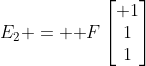 and 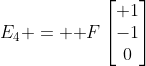 , and
that
T2
is
a linear map with eigenspaces 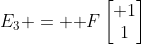 and 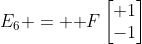 .
Find
the eigenspaces of T1 ⊗ T2 and
the dimensions of those eigenspaces.
H84. In (a)-(h), find
the Kronecker product A ⊗ B:
(a)
A =
 and B =  .
(b)
A =
 and B =  .
(c)
A =
 and B =  .
(d)
A =
and B =
.
(e)
A =
and B =
 .
(f)
A =
 and B =
for all a,
b, c, d ∊
𝔽.
(g)
A =
 and B =  .
(h)
A =
and B =
 .
H85. Find the rank of the Kronecker product A ⊗ B
for each of the following:
(a)
A and B given by H84(a).
(b)
A and B given by H84(b).
(c)
A and B given by H84(e).
(d)
A and B given by H84(g).
(e)
A and B given by H84(h).
H86. Let v ∊
𝔽n and
w ∊
𝔽m.
Show that vt⊗
w
= w vt,
where ⊗ denotes the Kronecker product.
H87. Let A and
B denote nxn
matrices with entries in 𝔽 and let I
denote
the nxn
identity matrix.
In
(a)-(d), ⊗ denotes the Kronecker product.
(a)
Show that (I
⊗ A)k
=
I
⊗ Ak and
(B ⊗ I)k
=
Bk ⊗
I,
for all k ∊
ℕ ∪ {
0 }.
(b)
Use (a) to show that eI⊗A
=
I
⊗ eA and
eB⊗I
=
eB
⊗ I.
(c)
Show that the matrices I
⊗ A and
B ⊗ I
commute.
(d)
Show that e(I
⊗
A)+(B
⊗ I
)
=
eB
⊗ eA.
If
any of the mathematics does not display properly (e.g., an error
message received), compare with this
file.
Recall
that a scan of the instructor's lecture notes can be found in the
Modules section of our Canvas portal.
Please
remember to complete online the student
feedback survey by 11
pm on Dec 7 --
check your mymav e-mail for the link.
I appreciate the
feedback (e.g., use of website, the use of Canvas, the choice of
homework questions from the book and/or the questions not from the
book, the information sheets and/or the solution sheets for the
tests, the examples provided in class, lecture notes provided on
onedrive, the Canvas graded homework (Q1 & Q2), use of videos,
corniness of jokes …??).
Thank you!
The
instructor (not GTA) will have
office
hours
after
Dec 7
as
noted below.
|
Dec
06
|
We
will spend today's lecture reviewing the course material &
addressing students' questions; no new homework.
Please
remember to complete online the student
feedback survey by 11
pm on Dec 7 --
check your mymav e-mail for the link.
I appreciate the
feedback (e.g., use of website, the use of Canvas, the choice of
homework questions from the book and/or the questions not from the
book, the information sheets and/or the solution sheets for the
tests, the examples provided in class, lecture notes provided on
onedrive, the Canvas graded homework (Q1 & Q2), use of videos,
corniness of jokes …??).
Thank you!
The
instructor (not GTA) will have
office
hours
after
Dec 7 as noted below.
|
Dec
09
4:30PM
|
Office
hour today 4:30-5:30
PM online only – see Canvas announcements for
the Teams link.
This is time the instructor is planning to be
on Teams for students to “drop by” to ask questions.
|
Dec
11
2:30PM
|
Office
hour today 2:30-4:30
PM in PKH 462 and online – see Canvas
announcements for the Teams link.
This is time the instructor
is planning to be in PKH 462 and on Teams for students to “drop
by” to ask questions.
|
Dec
13
3:00PM
|
Office
hour today 3:00-5:00
PM in PKH 462 and online – see Canvas
announcements for the Teams link.
This is time the instructor
is planning to be in PKH 462 and on Teams for students to “drop
by” to ask questions.
|
Dec
13
5:30PM
|
FINAL
TEST today,
starting at 5:30pm;
see Canvas for an
information
sheet.
Look over Tests 1-2 and
Q1-Q2 and
their solutions posted on Canvas to study for this test.
(Pay
attention to how the solutions on the solution sheets are written;
e.g., the level of detail provided in each solution.)
|
 MATH
4330 HOMEWORK (Fall 2021)
 Back to Dr
Vancliff's home page
 Back to Dr Vancliff's Fall
2021 teaching page
